
The Pre-Loved Goldmine Hiding in Your Products
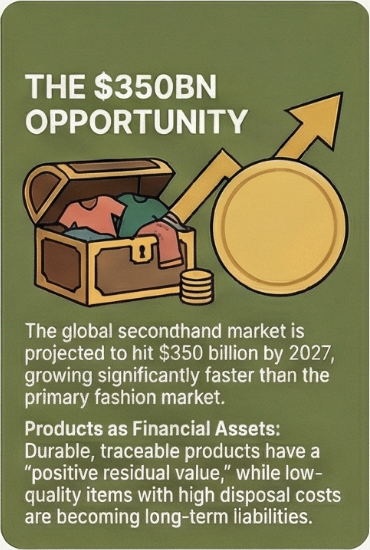
The global secondhand market is heading for $350 billion.
Most brands have no financial model for the value sitting in their own products after first sale. That's a commercial oversight as much as a sustainability one.
Here's a thought experiment. You design a product. You source it carefully, cost it, and sell it. In the traditional model, that's where the financial story ends - the product leaves the floor and disappears from your spreadsheets.
But the product still exists. It might be worn for three years, then passed to a friend, listed on Vinted, donated to a charity shop, or brought back through your own take-back scheme. Its story hasn't ended. It's just moved somewhere your cost price was never built to see.
The global secondhand apparel market is projected to hit $350 billion by 2027, growing at a rate that consistently outpaces the primary market. Resale, rental, refurbishment, repair - these are not niche trends. They are structural shifts in how fashion value is created and captured. And the brands building take-back programmes and resale channels are beginning to understand something important: the product you designed is still generating value long after you stopped tracking it.
If a product is designed to last and resell well, that's a financial asset. If it's made from virgin synthetic with no resale appeal and high disposal costs, that's a liability. Both belong in your cost price conversation.
Pre-loved value works in both directions. A durable, traceable product made from quality materials with strong secondary market demand has a positive residual value - one that could inform both the original design investment and the launch pricing strategy. A product that ends up in landfill because it can't be resold, repaired or recycled carries an end-of-life cost. That cost belongs in the model too.
Fairly Made's 2026 operational e-book talks about longevity and circularity as design inputs, not afterthoughts - which means they're commercial inputs too. And that's the mindset shift that matters here.
The pre-loved economy isn't coming. It's here. The question for every buying team is whether they're designing residual value into their products - or giving it away for FREE.
Why we need to talk…..
THE IMPACT MARGIN CALCULATOR
Pre-loved value is one of the most distinctive things about the Impact Margin Calculator - because it's the cost dimension that almost no other commercial tool even attempts to include. The calculator applies a residual value adjustment at product level, based on material durability, category, and secondary market demand. For BMD teams, it means that for the first time, the choice between a product built to last and one built to a price point shows up as a financial difference in the cost working - not just an ethical one.
Want to see what your margin really looks like ?
Book a free demo ourfashionfix.com/contact