
The Hidden Cost in Every Polybag
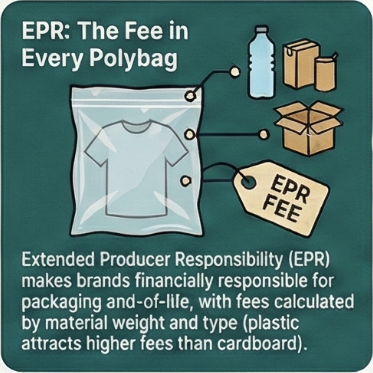
There's a fee attached to almost every piece of packaging your brand puts into the world. If it's not on your cost sheet, your margins are already wrong.
Think about the journey of a single product leaving a supplier. It's wrapped in a polybag. Placed in a box. Maybe cushioned with tissue paper. Possibly sealed with a branded sticker. Each one of those materials carries a cost that most buying teams have never seen on a cost sheet - but are already legally required to pay for.
It's called Extended Producer Responsibility, or EPR (for packaging). And if you're a brand or retailer placing packaged products on the UK or EU market, you are registered (or should be) for it. The principle is simple: the company that puts the packaging into circulation is financially responsible for what happens to it at end of life. That responsibility has a fee attached, calculated by material type and weight.
Plastic polybags attract a higher fee than recycled cardboard. Mixed-material packaging - think a polybag inside a printed box — incurs costs across multiple streams. These aren't rough estimates. They're published, regulated, and rising.
If your product ships in packaging that attracts an EPR fee, that cost belongs on your cost sheet as reliably as the fabric it's made from.
The problem? Most brands absorb EPR costs as a central overhead. Which means buyers can't see them - and what buyers can't see, buyers can't act on. A team choosing between a recycled cardboard box and a mixed-plastic polybag isn't making a neutral decision. They're making a financial one. They just don't know it yet. But you be sure that these costs are now visible to your finance team.
Cascale's climate data reinforces why this matters beyond today's fee schedule. With industry emissions still rising and regulatory pressure increasing, EPR (packaging) costs will only go one way. The brands building them into cost price now are building resilience. Those treating them as a central overhead are storing up a very nasty surprise.
The fix is genuinely straightforward: map the packaging on every product, look up the current EPR fee for each material, and add a per-unit cost to the cost sheet. Suddenly, your buyers are making informed decisions. That's how sustainability becomes operational - one line item at a time.
THE IMPACT MARGIN CALCULATOR
EPR for packaging is one of the first things we built into the Impact Margin Calculator - because it's one of the most concrete, calculable costs that BMD teams are currently flying blind on. The calculator pulls EPR fees through at product level, by material type, so that every packaging decision a buyer makes comes with a visible per-unit cost attached. No more absorbing it centrally and hoping for the best.
Curious what your current packaging is actually costing you per unit?
Book a free demo ourfashionfix.com/contact