
Five Lines That Could Change How You Cost Everything
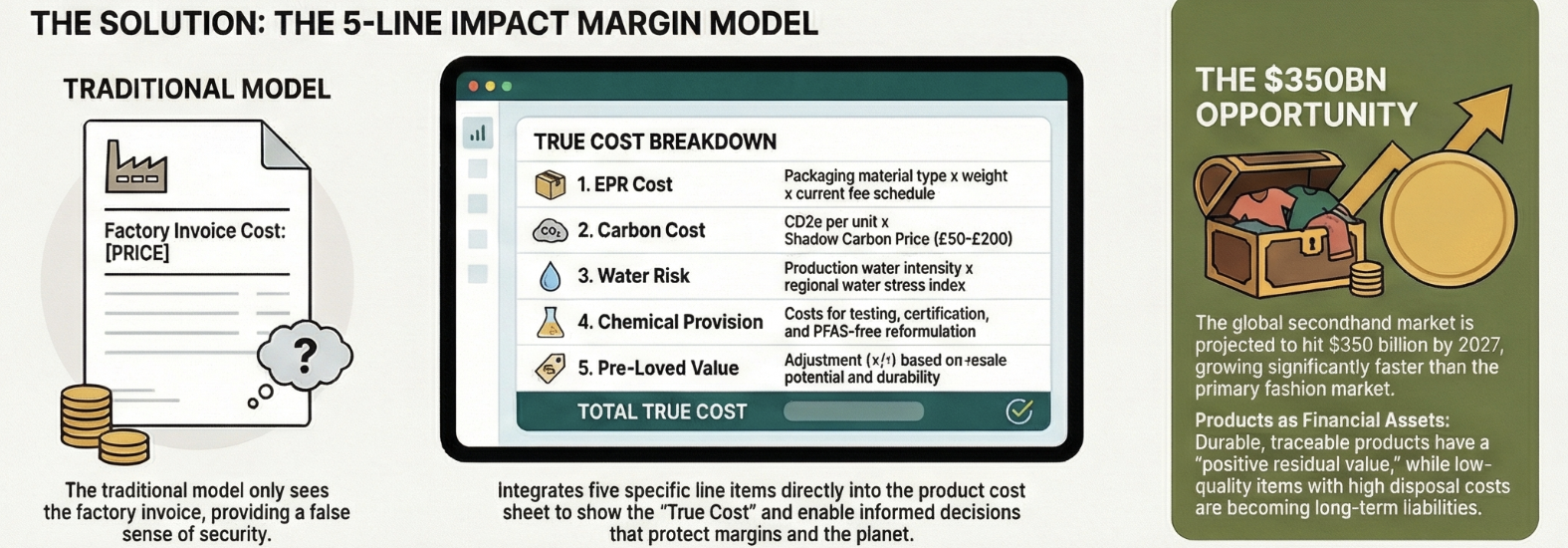
All week we've talked about what's missing from the cost price. Today, we get practical. Here's what a true cost price model actually looks like — and it's simpler than you might think.
If you've been following along this week, you'll have a good sense of the problem by now. The way most fashion brands and retailers cost product is missing some significant line items - EPR fees, carbon risk, water intensity, chemical compliance, and the residual value of the product after its first life.
The good news?
You don't need a new system to fix this.
You need five new lines in the model you already have.
Line one: EPR cost per unit. Map the packaging on each product - material type and weight. Look up the current EPR fee for each material from your compliance scheme. Add a per-unit cost to the cost sheet. Done. It's not an estimate - the fee schedules are published and updated annually.
Line two: carbon cost per unit. Take the CO2e per unit for the product - using supplier data, industry benchmarks, or lifecycle tools - and multiply it by a shadow carbon price. The Aii is clear that this is now a CFO-level decision. Review the shadow price annually as the regulatory floor rises.
These five lines don't make sustainability more expensive. They make the true cost of the product visible - and visibility is where better decisions start.
Line three: water risk premium. For water-intensive categories - cotton, denim, wet-process fabrics - apply a cost based on the water intensity of the production method and the water stress index of your sourcing region. Cascale's supply chain data tools can help you build this.
Line four: chemical compliance cost. Include testing, certification, and a provision for reformulation risk - particularly for performance outerwear, childrenswear, or anything using legacy chemical treatments under regulatory review.
Line five: pre-loved value adjustment. A positive or negative figure based on the product's realistic resale or recycling value. This makes circularity commercially visible at the point of the design brief - which is exactly where it needs to be.
Here’s one we prepared earlier….
THE IMPACT MARGIN CALCULATOR
We built the Impact Margin Calculator to do exactly this - all five lines, built into one tool, designed around how BMD teams actually work. You put in the product details. It gives you the true cost: EPR, carbon, water, chemical compliance and pre-loved value, calculated at unit level, before you commit to a purchase. It doesn't replace the commercial conversation. It finally gives that conversation everything it needs. This week's series has been about why the industry needs to change how it costs product. The Impact Margin Calculator is our contribution to making that change as straightforward as possible.
Keep it simple.
See all five lines in action.
Book your free demo today ourfashionfix.com/contact