
Welcome to our October edition of the Sustainable Fashion Update!
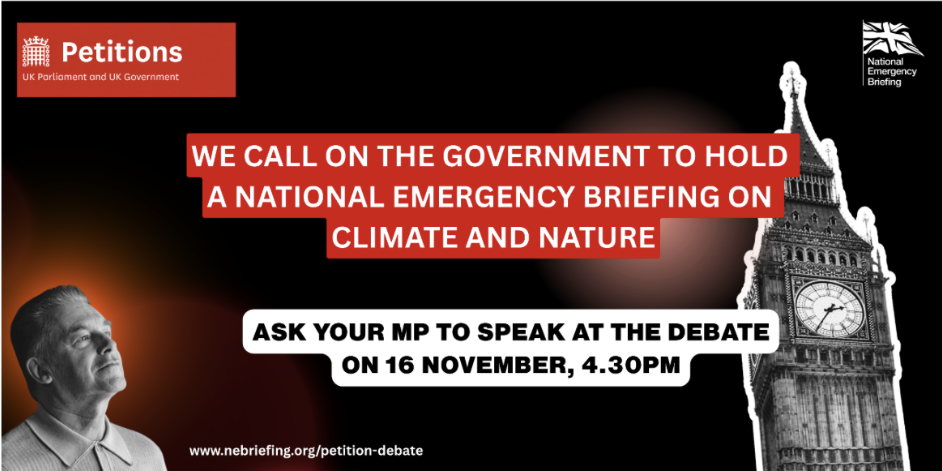
What a month it has been! Autumn has landed with a bang as Storms Austin and Boelo swept across the country, whipped up by what scientists are tracking as the strongest El Niño event on record. It is no wonder Prime Minister Andy Burnham has been making headlines with his new emergency preparedness list - urging everyone to stock up on essentials like bottled water, non-perishable food, torches, and backup cash in case severe weather or infrastructure failures hit. With folks stocking up on baked beans and Twiglets, and Chris Packham's People’s Emergency Briefing petition rocketing past 130,000 signatures to head straight for a parliamentary debate, there is a loud, growing demand for a transparent, honest look at the climate and nature crisis, especially when controversial decisions like approving new North Sea drilling keep happening right alongside it.
That environmental reality brings things straight back home to the fashion sector, where the pressure to move beyond surface-level pledges has never felt more urgent. Following yesterday's UK Budget announcement, rising business rates and operational overheads are forcing retailers to take a hard look at their bottom lines - proving that sustainability can no longer be an add-on, but must drive genuine commercial transformation. From major biotech breakthroughs scaling up circular materials and stark new findings on global living wages, to the debate around secondhand apps and overproduction, this month's roundup covers all the key insights shaping the industry right now.
Policy & Regulation
UK Budget 2026: Retailers Divided as Business Rates Spike Hits Major Chains: Following the government's Autumn Budget announcement, UK retailers find themselves sharply divided over the fiscal measures. While smaller independents benefit from targeted reliefs and lower property footprints, major high-street brands face a far tougher impact. For large retailers, surging business rate bills across extensive store portfolios threaten to completely wipe out last year's hard-won cost savings, leaving retailers to balance rising fixed overheads against squeezed commercial margins. Read the full report on Retail Insight Network
UNEP 2026 Emissions Gap Report Warns 1.5°C Overshoot is Inevitable: The UN Environment Programme’s latest Emissions Gap Report delivers a stark warning: current global policies are tracking toward a 2.8°C temperature rise, closing the window to limit warming to 1.5°C without significant overshoot. For the fashion sector, where emissions remain concentrated in energy-intensive wet processing and synthetic material production, the findings signal an urgent end to long-dated net-zero pledges in favour of immediate, deep decarbonisation across raw material sourcing and manufacturing networks. Read the full report on UNEP
National Emergency Briefing
National Emergency Briefing The People’s Emergency Briefing Petition is Going to Parliament: Over 130,000 people have signed Chris Packham’s petition calling for a live emergency briefing to the nation on the climate and nature crisis, introduced by the Prime Minister and delivered by independent experts. Now Parliament is going to debate it, on 16 November at 4.30pm.
British Public Ambition for UK Nature Protection Outpaces Government Targets: New research from The Wildlife Trusts reveals a strong gap between public desire and official policy: while just 11% of UK land and sea is currently protected, the public wants that figure to exceed 60% - more than double the UK Government's official 30x30 target. The findings highlight mounting pressure on ministers to translate public backing into legally binding conservation action ahead of 2030 deadlines. Read the full article on LinkedIn
Shein Faces Mounting Global Regulatory Penalties: Shein has agreed to pay $100M, wiping out nearly half of its Q2 profits - to settle a U.S. FTC investigation into shipping delays, unfulfilled orders, and poor customer service. The penalty adds to growing global regulatory headwinds, following a €40M fine in France over misleading discounts and a $700K settlement in California for fulfillment and refund violations. https://lnkd.in/gckZC_Nh
Cout Environmental
Rental Resale & Repair
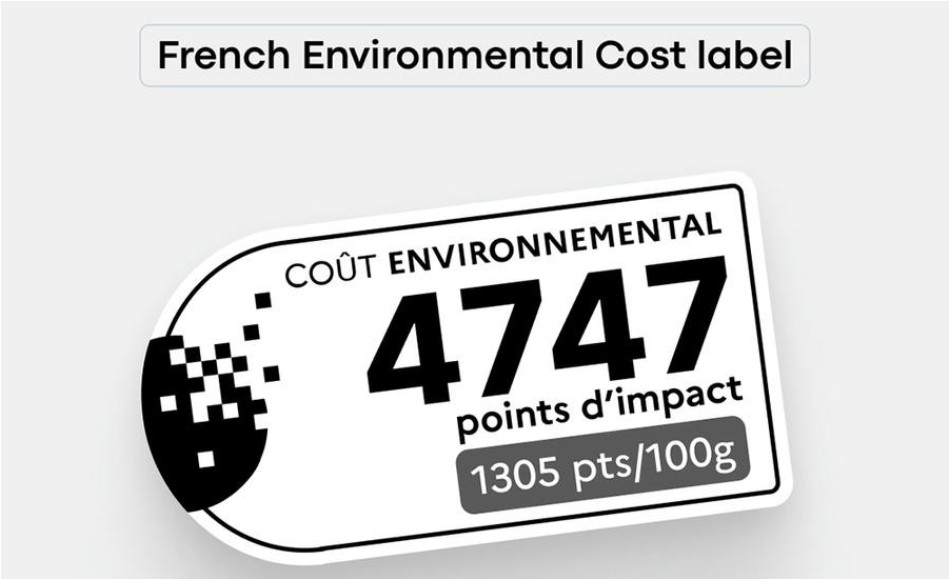
France’s Mandatory 'Coût Environnemental' Takes Effect: France’s official textile environmental labelling scheme, the Coût Environnemental (formerly the French Eco-Score), entered a critical new phase this October. While displaying the score remains voluntary in principle, it is now legally mandatory for any brand communicating environmental claims or ratings on products sold in France. Crucially, third parties, including NGOs, competitors, and retail platforms, are now legally permitted to calculate and publish a brand's score using government default data. Because default assumptions skew conservative and yield significantly worse scores, brands selling the 11 in-scope apparel categories are urged to register their own primary product data to protect their commercial reputation. Read the complete French Eco-Score guide for brands on Zenero
COP 31 will take place in Antalya, Türkiye, from 9–20 November 2026: Set to focus heavily on the "era of implementation," the summit aims to establish new benchmarks for climate ambition, risk mitigation, and climate finance delivery. COP31 Türkiye Antalya 2026 UN Climate Change Conference
WRAP Launches Textile Collections Transition Programme: Environmental NGO WRAP has launched the global Textiles Collections Transition Programme, bringing together key industry players to redesign how post-consumer garments are collected, sorted, reused, and recycled. Backed by major UK retailers including Next, Primark, and Tesco, Phase 1 focuses on building transparent, financially viable collection models that divert textiles from general waste and secure high-quality feedstock to help scale global fibre-to-fibre recycling. Read the official press release on WRAP
German Red Cross
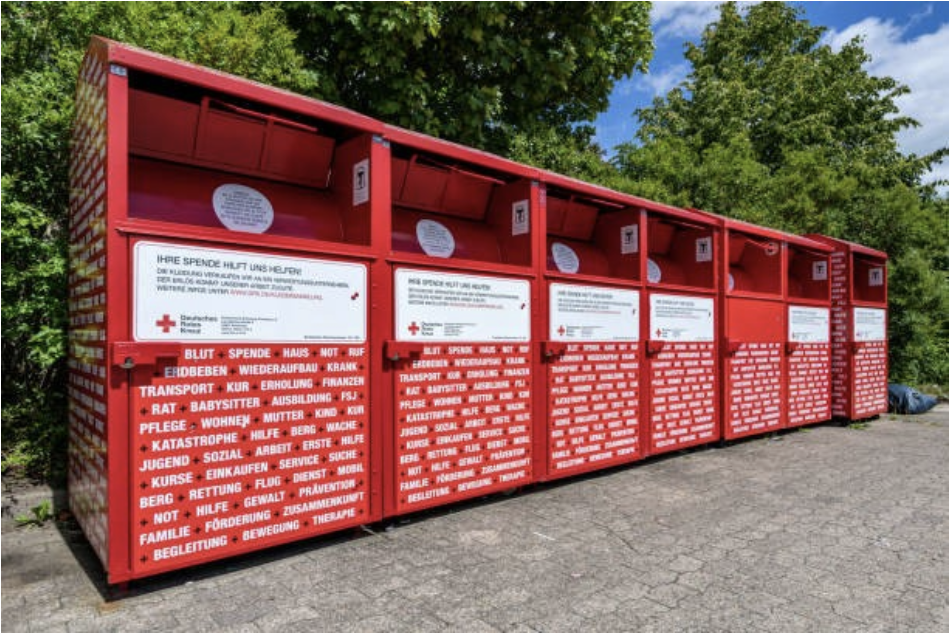
Textile Recycling Crisis: German Red Cross Withdraws Clothing Banks: The mounting global textile recycling crisis has claimed another casualty, with the German Red Cross announcing the withdrawal of its remaining clothing collection banks from the Vogelsberg district in Hesse. Driven by plunging resale revenues, falling garment quality, and surging operational overheads, the closure highlights the severe financial strain facing traditional charity collection and donation networks across Europe. Read the full article on Apparel Insider Read the full article on Apparel Insider
Tax Policy Reform: Circular VAT as a Competitiveness Lever: A compelling proposal from the Circular Fashion Federation (Fédération de la Mode Circulaire) highlights how introducing a reduced "Circular VAT" rate on repair services and secondhand sales can transform the economics of circular fashion. By lowering taxation on circular business models, policymakers can help brands unlock higher gross margins, make repair and resale commercially competitive against linear fast fashion, and incentivize long-term reinvestment into sustainable supply chain infrastructure. Read the full insight from the Circular Fashion Federation
Circularity & Materials Innovation
Ponda
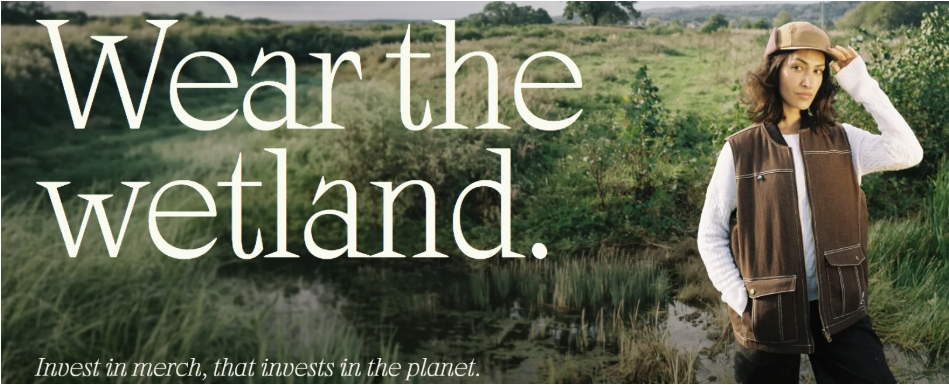
Ponda Launches "Wear the Wetland" Direct-to-Market Collection: Biomaterials innovator Ponda (formerly Saltyco) has launched its Wear the Wetland gilet collection, taking its novel BioPuff® insulation straight to market via corporate merchandise and team uniforms. Derived from wetland-restoring bulrush plants, BioPuff® offers a plant-based alternative to animal down and synthetics. Limited single-batch runs are now available starting at 100-unit minimum orders. Ponda - Planet Regenerating fibres
Carbios and Global Brand Consortium Unveil Recycled Polyester T-Shirts: French biotech pioneer Carbios, working alongside major brand partners On, Patagonia, PUMA, PVH Corp. (parent of Calvin Klein and Tommy Hilfiger), and Salomon have successfully produced 100% enzymatically recycled polyester T-shirts from complex, blended textile waste. Bypassing traditional clear plastic bottle feedstocks, the multi-brand consortium utilized targeted enzymes to break down post-consumer garments back into virgin-quality monomers, marking a major milestone for fibre-to-fibre circularity. Read the full article on Textile Today
New Open-Source Open Dataset Targets Automated Textile Sorting: Researchers in Portugal have published the HyperTex dataset—a 161.5GB collection of 198 hyperspectral scans featuring pure fibers and complex commercial blends. By training machine-learning models to accurately detect garment fiber composition at high speeds, the project directly targets the sorting bottleneck currently stalling industrial-scale textile-to-textile recycling. Read the full article on Apparel Insider
Primark Partners with Circ® to Scale Textile-to-Textile Recycled Polyester: Primark has partnered with textile innovator Circ to introduce recycled polyester made from post-consumer textile waste at scale across its collections by 2029. Delivered under the Primark Cares strategy, the collaboration marks a major commitment by a global value retailer to move away from virgin polyester in favor of circular, poly-cotton recycling technology. Read the official announcement on Primark Corporate
Circ® Partner with Huafon to Build Supply Chain Scaling in China: US textile-to-textile innovator Circ has partnered with Chinese materials producer Huafon Group. Locating chemical recycling capacity directly within China, the world’s dominant textile manufacturing hub, allows Circ to process complex poly-cotton waste blends locally, making recycled polyester and cellulosic fibres available as feedstock directly within major production regions. Read the full breakdown on Forbes
The Nature Conservancy Launches Microfibre Action Alliance: The Nature Conservancy (TNC) has launched the Microfibre Action Alliance (MAA) to combat global aquatic microfibre pollution. Backed by founding members Nike, Patagonia, Under Armour, lululemon, and REI, the initiative shifts focus upstream toward material design, mill-level filtration, and manufacturing processes. Accounting for over 30% of ocean microplastics, with natural fibres like cotton and wool also contributing to ecosystem loads, the MAA aims to complement the scientific work of The Microfibre Consortium by driving standardized, supply-chain-wide implementation. https://www.just-style.com/news/tnc-apparel-alliance-microfibre-pollution/

E.L.V DENIM
E.L.V. DENIM and Sanderson Design Group plc. Launch Upcycled Interior Textile Line: E.L.V. DENIM has teamed up with Sanderson Design Group plc to transform surplus home interior fabrics into wearable luxury fashion. Made locally across East London ateliers, the collection combines deadstock furnishings with reclaimed denim to create distinctive upcycled garments now available at Liberty. Read the full feature on FT How To Spend It
October Was Wool Month. Ultrafine Merino Wool for Sleep & Recovery: Technical sleepwear innovation is expanding the performance boundaries of natural fibers. Recent research shows that sleeping in wool can boost REM sleep by up to 25% - supporting better memory consolidation, physical recovery, and daytime alertness. Advanced fabric developments utilizing 15.5-micron ultrafine Merino wool and hybrid knit structures deliver ultra-lightweight, next-to-skin comfort paired with natural thermoregulation for uninterrupted rest. Download the toolkit and explore the collection on LinkedIn
Consumer Preference Shifts to Natural Fibres: To mark Wool Month this October, new global research from The Woolmark Company and Ipsos reveals a clear consumer shift toward natural materials. Given equal price, style, and fit, 82% of shoppers surveyed would choose natural fibres over synthetics, with Merino wool consistently preferred over polyester. Reflecting this demand, Google searches for "Merino wool" have more than doubled over the last five years. Furthermore, 67% of consumers are willing to pay a premium for natural compositions, provided brands offer independent certification to back up their claims. Read the full research report on Just Style
Outerknown Expands Recycled Wool Line: Sustainable apparel brand Outerknown has launched its Fall 2026 ‘Woolaroo’ collection, crafted from 100% recycled wool without the use of virgin fibres or polyester. Developed in partnership with renowned Italian textile mill Manteco, which has specialised in circular wool recycling since the 1940s, the collection presents a natural, high-performance alternative to traditional synthetic fleeces. Read the launch details on Shop Eat Surf Outdoor

PRADA Re-Cashmere
Prada Launches Re-Cashmere and Re-Wool: Building on the success of its Re-Nylon initiative, Prada has expanded its circular material strategy with the launch of Re-Cashmere and Re-Wool. The projects repurpose pre-consumer industrial waste, including spinning residues, cutting-room offcuts, and factory remnants, converting them into refined Italian-made knitwear and tailoring. Produced strictly according to available waste volumes, the limited collections feature embedded NFC tags linking directly to digital passports for full supply chain traceability. Read the full feature on Hypebeast
Fashion for Good Launches Cotton Reloop Matrix: Fashion for Good has launched the Cotton Reloop Matrix project to overcome technical barriers in mechanical cotton recycling, such as fibre shortening and loss of yarn strength. Backed by partners including Arvind, BESTSELLER, C&A, Reformation, and Shahi, the initiative will map recycler capabilities against brand specifications across real-world mill trials. The project will publish an open-source spinning guide and trade-off analysis to establish clear commercial standards for balancing recycled content percentage, fabric quality, and production cost. Read the full announcement on Fashion for Good
Recover Expands Recycled Fibres Without Overdyeing: Recycled cotton producer Recover has launched a new range of high-value recycled fibres achieved without overdyeing. By relying entirely on precise mechanical sorting of post-industrial and post-consumer textile waste by colour, the process eliminates the water, chemical, and energy consumption typically required in wet processing. The collection offers fashion brands a lower-impact, closed-loop solution that reduces resource use while preserving fibre integrity and colour consistency. Read the full article on FashionUnited
ARMEDANGELS Develops Plastic-Free Bouclé: Sustainable fashion brand Armedangels has introduced a plastic-free bouclé fabric engineered entirely from natural and cellulosic fibres. By blending organic wool with Tencel Lyocell, the brand successfully replaces the synthetic polyester and polyamide filaments traditionally required to achieve the textured loop structure of bouclé. The development offers retail buyers a circular, microplastic-free alternative for cosy autumn/winter knitwear and outerwear. Read the full article on FashionUnited
Brightfiber Textiles Halts Amsterdam Fibre Production: Dutch recycler Brightfiber Textiles has suspended fibre production at its Amsterdam plant due to financial pressures, citing delayed enforcement of recycled-content legislation, tightening brand sustainability budgets, and a lack of scaling capital. The company will continue sorting and material preparation while seeking European partners to outsource fibre processing, reflecting broader commercial headwinds across European textile recycling. Read the full report on Apparel Insider (Note: link text retained as provided)
Primark joins the Denim Deal: Primark joins the Denim Deal to scale the use of post-consumer recycled cotton in its jeans. The initiative brings together brands, manufacturers and recyclers to tackle the barriers to recycling old denim. It builds on Primark's first recycled denim capsule, made without elastane or metal rivets to ease recycling. Read more: https://lnkd.in/epU9VVcq
Retail Highs and Lows
Adidas Upgrades Profit Outlook: Adidas raised its 2026 operating profit guidance from €2.3bn to €2.5bn following a strong third quarter. Preliminary Q3 operating profit jumped 37% to €1bn on revenues of €7.3bn, with gross margins hitting 54.3%, driven by full-price sales and a €200m US tariff refund.
Mulberry Reports H1 Growth: Mulberry posted an 18.2% increase in first-half group sales at constant currency for the 26 weeks to 26 September. Performance was driven by international growth and steady full-price demand, with UK like-for-like sales rising 9%.
Cyber Incident at TFG Brands: TFG Group is investigating a cyber incident affecting IT systems at Hobbs, Whistles, and Phase Eight to determine potential data exposure. Stores remain open and operational, while White Stuff, Inside Story, and TFG's African and Australian businesses are unaffected.
Ralph Lauren Replaces Executive Sustainability Bonus Metrics with AI Targets: Ralph Lauren has dropped ESG and sustainability goals from its executive short-term incentive plan, replacing them with a new "AI scorecard" based on employee training, literacy, and internal feedback. The move comes alongside wider scrutiny over the brand's long-term climate commitments; after retiring its 2040 net-zero target in late 2025 in favor of rolling five-year goals, Ralph Lauren holds a D+ score on Stand.earth’s Fossil Free Fashion Scorecard, which noted that coal continues to power roughly 31% of its manufacturing footprint. Ralph Lauren shoppers are at the center of its next big move - Ralph Lauren shoppers are at the center of its next big move - TheStreet

Stella McCartney’s ‘Wild Horses’ Campaign
Backlash Over Stella McCartney’s ‘Wild Horses’ Campaign: Stella McCartney’s latest ‘Wild Horses’ short film and campaign starring Kylie Jenner has sparked consumer backlash surrounding brand alignment. While the campaign aims to highlight wild horse protection and donate to global equine charities, critics have questioned whether casting a fast-fashion influencer aligns with the brand’s core sustainability and animal welfare ethos, shifting public focus away from the environmental message and onto casting authenticity. Wild Horses starring Kylie Jenner | Stella McCartney (Note: link text retained as provided)
Abercrombie & Fitch Under Fire Over Viral 'Pink Tax' Sweater: Abercrombie & Fitch has faced public backlash following a viral social media video highlighting material discrepancies in similarly priced items. A shopper compared two $85 crewneck sweaters and revealed that while the men's version was crafted from 100% merino wool, the women's version at the identical price point contained just 25% wool alongside 75% synthetic and cotton blends. The contrast has reignited debate over the "pink tax" in apparel retail, with critics pointing out both price-to-quality imbalances and the environmental impact of lower-durability synthetic blends. Read the full breakdown on Subplot
The Very Group Posts £317.5m in Adjusted EBITDA: For the 52 weeks ending 27 June, The Very Group reported flat overall revenue at £2.1bn, while profitability climbed with a 3.4% rise in adjusted EBITDA. Performance was supported by steady momentum in Very UK, which grew 1.3% to £1.9bn led by solid growth in home sales.
Supply Chain & Ethics
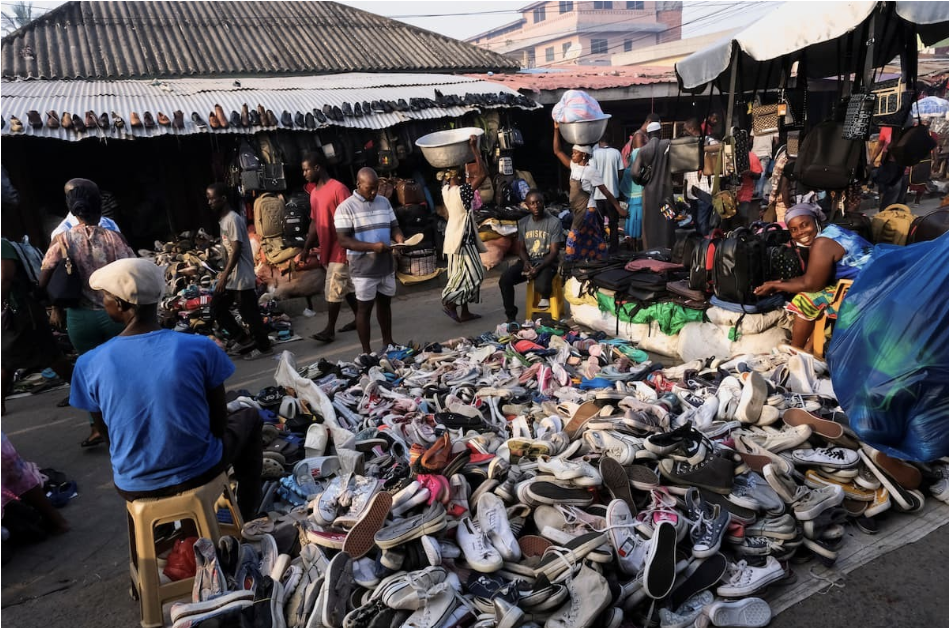
Kantamanto Market
Major Brands Launch Apparel Recovery Coalition to Tackle Waste Colonialism: Fashion heavyweights adidas, H&M group, Inditex, and BESTSELLER have partnered with Ghana-based NGO The Or Foundation to launch the Apparel Recovery Coalition (ARC). Centered in Accra’s Kantamanto Market - one of the world’s largest secondhand clothing hubs - the multi-year pilot will fund local reuse, repair, upcycling, and waste remediation while testing international Extended Producer Responsibility (EPR) models to address post-consumer garment exports. Read the full article on Modaes
Better Cotton Initiative Transitions to External Regenerative Certification Standard: BCI, the world's largest cotton sustainability initiative, has officially pivoted from a non-profit stakeholder organisation to an external regenerative standards system. The strategic overhaul is designed to align corporate sustainable sourcing goals with farm-level execution, using certified regenerative metrics focused on soil health, ecosystem resilience, and farmer livelihoods to verify impact across global supply chains. Read the full update on LinkedIn
Bangladesh Moves Toward New Garment Worker Minimum Wage: The Bangladeshi government is set to form a new wage board to determine minimum pay for garment sector workers, countering manufacturer calls to defer the review to 2028. With worker and employer representative nominations currently underway, negotiations are expected to begin shortly to evaluate floor pay against regional standards and economic conditions. Read more: https://lnkd.in/eA3FCp-N
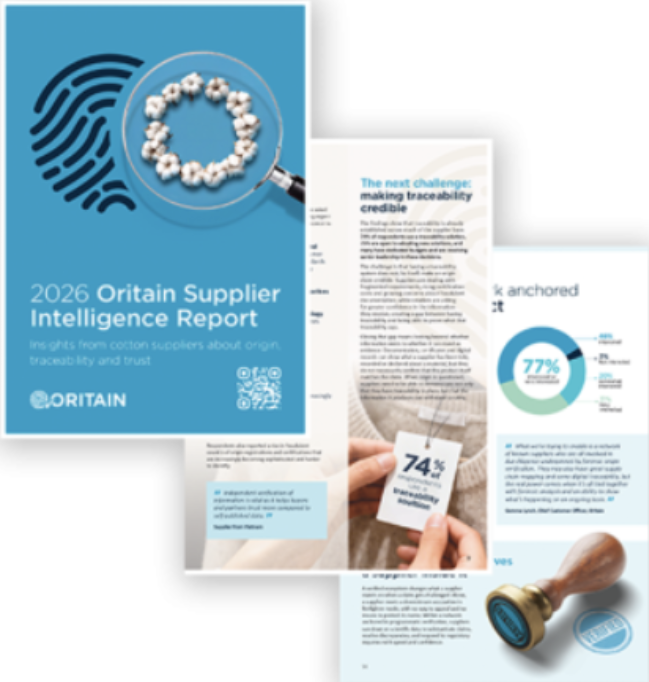
2026 Oritain Supplier Intelligence Report
New Oritain Report: New Oritain report finds cotton suppliers are more open to transparency than the industry gives them credit for. But having traceability is not the same as having evidence. As forced labour bans spread, tariffs tie closer to origin, and border controls tighten, suppliers are being asked to verify that their records match the fibre itself. 2026 Oritain Supplier Intelligence Report | Oritain
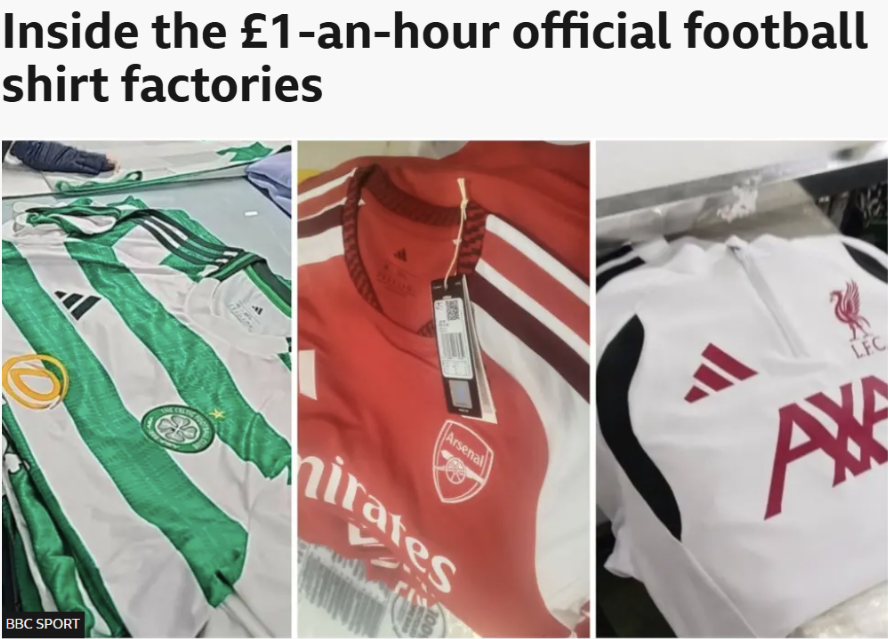
BBC Sport
BBC Investigation Exposes £1-an-Hour Shirt Production for Premier League Football Shirts: A BBC Sport investigation has revealed that official Premier League football shirts, which retail for up to £130 in the UK, are being manufactured by workers earning basic wages of less than £1 an hour. Traced to garment factories in Cambodia, the findings put major sportswear brands and elite clubs back under intense scrutiny over supply chain transparency, extreme profit margins, and living wage compliance in tier-1 and tier-2 manufacturing hubs. Read the full investigation on BBC Sport
HUGO BOSS to Rejoin Pakistan Accord: German fashion house Hugo Boss has announced it will rejoin the Pakistan Accord effective January 2027, reversing its earlier decision not to renew its participation. The legally binding health and safety agreement, born from the broader International Accord established following the Rana Plaza tragedy and the Ali Enterprises factory fire, commits global brands and retailers to rigorous worker safety standards across manufacturing hubs. Read the full article on LinkedIn
Baptist World Aid Releases 2026 Ethical Fashion Report: Baptist World Aid, Australia’s 11th annual Ethical Fashion Report has revealed that overall progress on garment worker rights has stalled across the industry. Assessing 138 apparel companies representing 543 brands, the report found that only 13% of businesses could provide evidence of paying a living wage to workers anywhere in their supply chains. While more brands are adopting fair wage policies, the findings underscore a persistent gap between formal corporate commitments and verifiable execution on factory floors. Read the full article on Ecotextile News
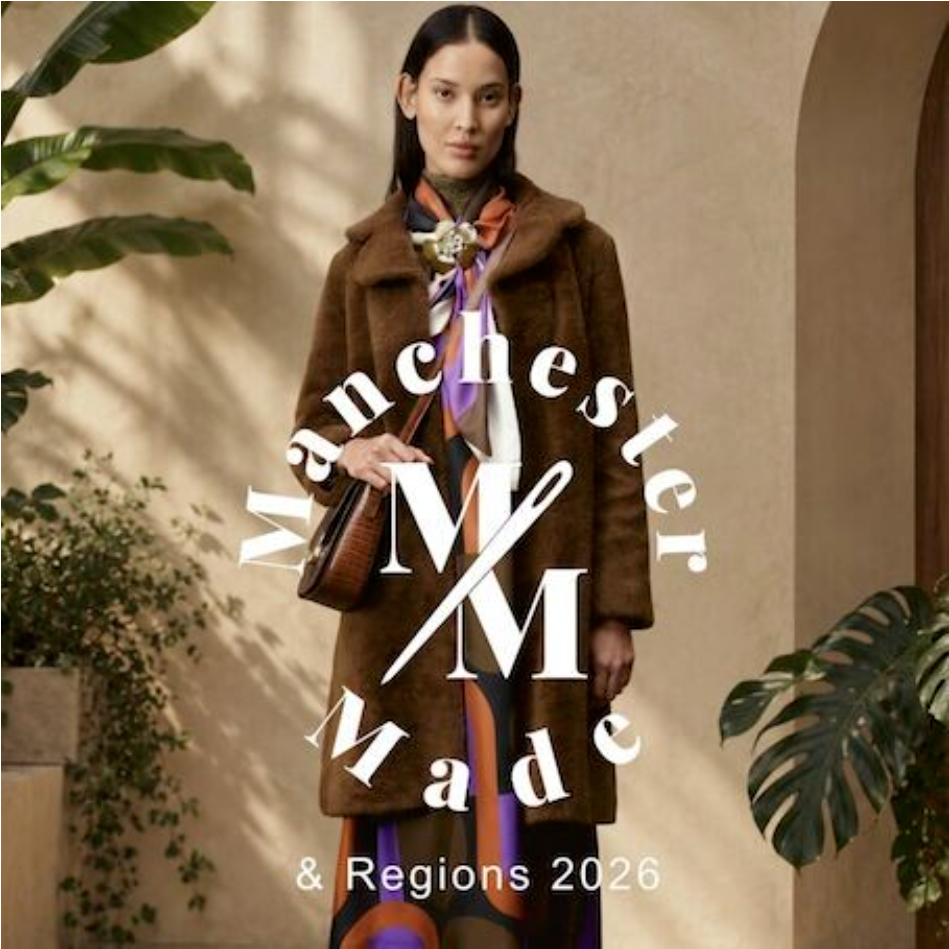
Manchester Made
Fashion-Enter Ltd/ FashionCapital and Source Fashion Launch Manchester Made: Building on the success of Leicester Made, Fashion-Enter and Source Fashion are launching Manchester Made & Regions on Wednesday 4 November 2026 at Manchester Hall. Supported by the Apparel and Textile Manufacturers Federation (ATMF), the inaugural event connects UK brands, buyers, and retailers directly with domestic manufacturing capabilities, exploring the commercial case for nearshoring, skills development, and stronger supply chain partnerships. Manufacturers can apply to exhibit here.🎟️ Buyers, brands, and retailers can register for a free place.
Chez Rock
LaundRE Partners with Chet Rock for Denim Launch: Celebrating shared East London roots, LaundRe handled the washing and finishing for streetwear brand Chet Rock's latest collection. The campaign video, filmed entirely inside LaundRe's working laundry, showcases the power of domestic production - bringing creativity and UK-based denim finishing side by side. Watch the campaign video on LinkedIn
Impact & Sustainability Reports
WEF Report: Sustainability Moves from Compliance to Commercial Value: The World Economic Forum’s inaugural Chief Sustainability Officers' Outlook highlights a key shift: 63% of CSOs expect sustainability progress to hold steady or accelerate over the next year, despite 78% anticipating macro and political headwinds. Far from a contradiction, the finding reflects how sustainability is increasingly integrated into core business decisions—from energy and resource efficiency to long-term capital allocation. The central challenge now is ensuring environmental strategy actively drives commercial value and operational resilience, even as conditions fluctuate. Read the WEF Chief Sustainability Officers' Outlook September 2026
Earthmark
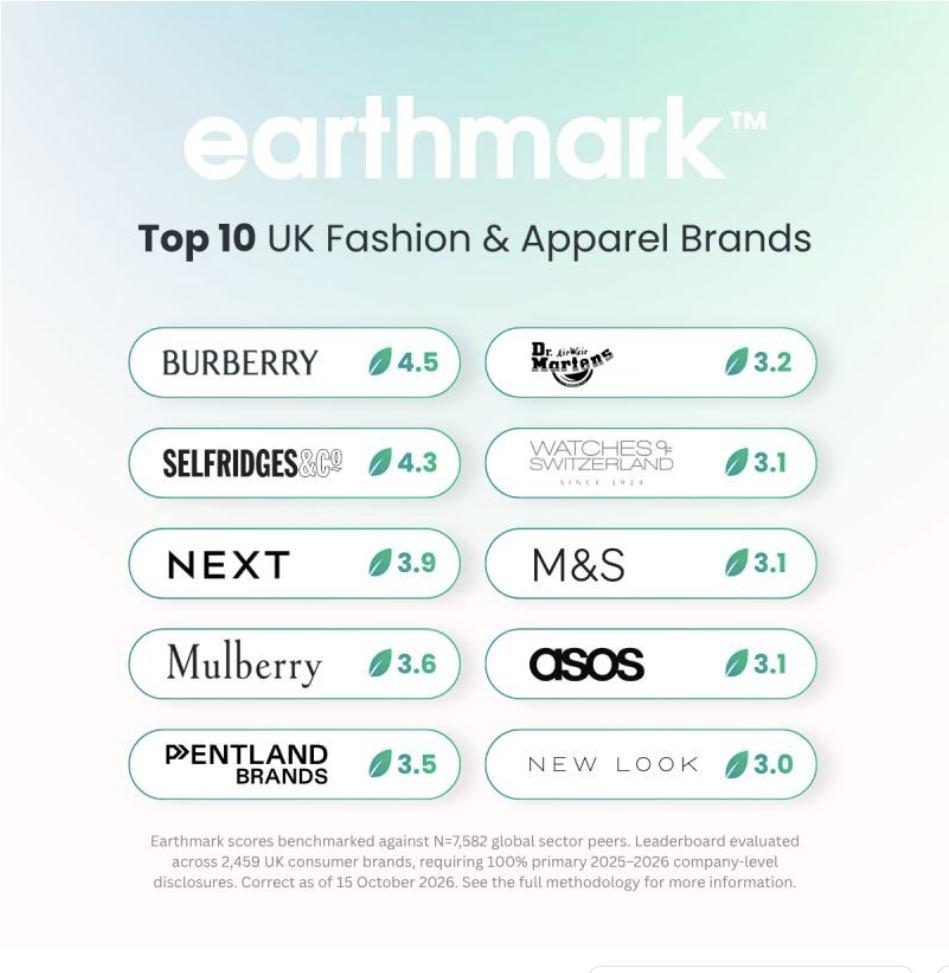
Earthmark Ranks UK Fashion Brands on Climate Data Transparency: Earthmark analysed over 2,400 UK consumer brands to rank fashion leaders based on the quality, consistency, and accessibility of their primary environmental reporting. Burberry took the top spot with a score of 4.5/5.0, followed closely by Selfridges (4.3) and Next (3.9). Mulberry, Pentland Brands, Dr. Martens, Watches of Switzerland, M&S, ASOS, and New Look also earned places in the top ten, reflecting a growing push for verified primary disclosures across high-street and luxury sector. View the full Top 10 UK Fashion & Apparel Brands by Earthmark Score 2026
WRAP Textiles Report Exposes the Scale of UK Fashion Overproduction: Co-authored by Flourish CSR for the UK Textiles Pact, WRAP’s new report establishes a formal definition for overproduction and investigates what truly happens to unsold stock. Based on insights from commercial practitioners, the study reveals the hidden costs of high online returns, manufacturing buffers, and surplus garments overwhelming secondary recycling networks. Read the full report on LinkedIn
FatFace
FatFace ESG Impact Report: Fatface published their latest ESG Impact report, reflecting on the progress made over the past year against their Product, Planet and Community pillars. Key highlights include: supporting suppliers on decarbonisation: launching new partnership agreements with key manufacturing suppliers to support emissions measurement and reduction across the supply chain. Strengthening raw materials sourcing: creating a Preferred Materials Guide which helps teams choose the most suitable components for every product and taking impact into consideration. Positive impacts in the community: FatFace Foundation has now donated over £3 million to charitable causes since its inception. https://lnkd.in/esna_ccj
Mulberry England Releases 2026 Impact Report: Mulberry has published its 2026 Impact Report, marking five years of its Made to Last Manifesto alongside its recertification under B Lab UK's updated B Corp standards. Key operational achievements include switching to 100% renewable electricity across sites under its operational control and cutting emissions per unit from 61.3 to 43.67 kgCO₂e. On circularity, the luxury brand generated £1.216m through The Mulberry Exchange recommerce platform, repaired over 9,000 products via its Lifetime Service Centre, and introduced its first products crafted from British Pasture Leather. Read the full Mulberry 2026 Impact Report on LinkedIn
Better Cotton Initiative Releases 9-Year Impact Report Findings: The Better Cotton Initiative has published its comprehensive 9-year impact report, evaluating nearly a decade of farm-level data across global cotton-producing regions. The findings highlight measurable progress in reducing chemical pesticide use, improving water stewardship, and supporting sustainable farming livelihoods, while also emphasizing the ongoing challenge of scaling physical traceability and verifiable data across complex global supply chains. Read the full findings on the Better Cotton website
Resale, Rental & Repair
CTR Group Acquires Hirestreet to Bridge Fashion Rental and Resale: CTR Group, the reverse logistics and circular economy business behind Thrift+ has acquired UK fashion rental platform Hirestreet to scale its subscription operations. The strategic deal creates an integrated circular loop, allowing garments to transition seamlessly from rental lifecycles into resale via Thrift+ before showing wear. Read the full story on TheIndustry.fashion
CTR Group Launches ZOA Group: CTR Group has formed ZOA Group, combining Hirestreet, Thrift+, Wowzer, and Reuseabook into a unified platform managing surplus stock and returns across rental, resale, repair, and recycling. Operating across 20 sales channels, the group plans to make two additional acquisitions by the end of 2026.
Patagonia Integrates Resale Into Main E-Commerce Platform: Patagonia has fully merged its Worn Wear second-hand business into its main global website, allowing customers to browse and purchase new and used clothing within a single checkout experience. Alongside bringing all Worn Wear warehousing, shipping, and customer service operations in-house, the structural shift aims to make circularity a core sales driver by placing used items directly alongside new production to maximize garment lifespans. Read the full article on Sustainability Magazine

Lucy & Yak
Lucy & Yak Hosts Sheffield Circular Fashion Fair: Independent apparel brand Lucy & Yak celebrated keeping over 50,000 garments in circulation through its Re:Yak take-back scheme with a three-day Circular Fashion Fair in Sheffield. Featuring pre-loved rails, interactive darning, screen-printing workshops, and local indie pop-ups, the festival-style event demonstrated how engaging community circularity can be. The milestone also marked the launch of its new Repairs for Life initiative, offering free lifetime repairs for eligible UK loyalty members to further extend garment lifespans. Read the full story on Business Mondays
eBay Cuts 9% of Workforce Amid Resale Push: eBay is cutting approximately 1,000 jobs (around 9% of its global workforce) in its second round of redundancies this year. The restructuring aims to streamline operations and reallocate resources toward high-growth focus areas, including authenticated luxury and circular fashion, following its $1.4bn acquisition of resale platform Depop.
eBay 2026 Recommerce Report
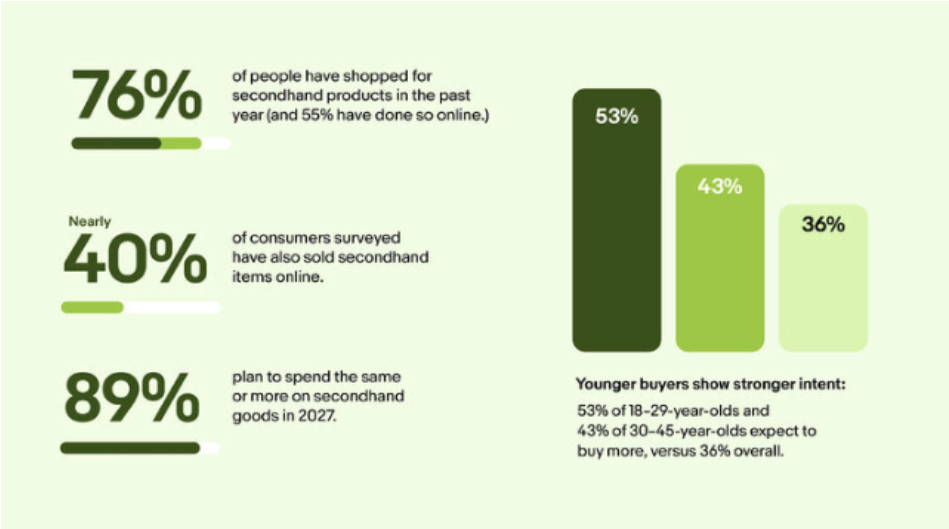
eBay has published its 2026 Recommerce Report, highlighting a significant and sustained surge in consumer demand for secondhand fashion. The data reveals that pre-owned shopping is increasingly becoming mainstream behaviour rather than a niche alternative, driven by cost-of-living pressures and growing environmental awareness. For retail brands, the findings underline the commercial urgency of integrating recommerce models and circular take-back schemes into their core strategies. 2026 Recommerce Report - eBay Inc.
Reports and Research
Study Models Global Market Without Fast Fashion & Exposes Fiber 'Substitution' Myth: New study by the Universities of Helsinki and Graz modeled the global fibre market (2004–2021) to quantify fast fashion’s true impact, finding that without its rapid growth, synthetic production would have been 47% lower, cellulosics 45% lower, and cotton 13% lower by 2021. Crucially, the research revealed that adding NextGen or lower-impact fibres rarely replaces traditional materials - an extra unit of one fibre reduced competing fibre production by only 0–32%, proving that new fibre volume is largely additive rather than restorative. Read the full article on Apparel Insider
Consumer Demand Propels Sustainability in Athleisure: According to industry specialists, the athleisure sector is experiencing a significant green shift driven primarily by conscious consumers pushing for greener choices. As activewear brands face rising expectations around eco-friendly materials and circular practices, the market is proving that performance wear and sustainability can go hand in hand. FashionNetwork's report
Circular Fashion News
State of Textile Recycling H1 2026: This report, published by Circular Fashion News, provides a comprehensive look at the state of textile-to-textile recycling. It highlights that while global markets are growing - with Europe expanding at a 10.5% CAGR - scaling infrastructure faces severe funding hurdles, price premiums on recycled fibres, and a lack of firm brand purchasing agreements. Navigating these challenges requires stronger regulatory frameworks like Extended Producer Responsibility (EPR), increased investment, and greater transparency across supply chains. You can read the full report here Circular Fashion News
The Vinted Paradox: Is Secondhand Shopping Fueling Hyper-Consumption?: A feature in The Observer examines the unintended environmental consequences of the C2C resale boom. While platforms like Vinted promote circularity, Mark Sumner of WRAP warns of a growing paradox: ultra-low entry prices and frictionless shipping are encouraging consumers to buy higher volumes overall. The trend raises critical questions about whether secondhand apps are genuinely displacing new fast-fashion production or simply normalising a faster turnover of disposable clothing. Read the full article on The Observer Vinted is currently the #1 free app on the US App Store, overall - ahead of Muse, ChatGPT, and TikTok.
All Rise! The incredible true story of how 27 Pacific Island students inspired a global climate breakthrough. An inspiring documentary, presented in partnership with Wellcome Trust, tells the story of how 27 South Pacific law students have redefined nternational law on climate change. Independent TV | Latest and trending video
Bristol Fashion Show
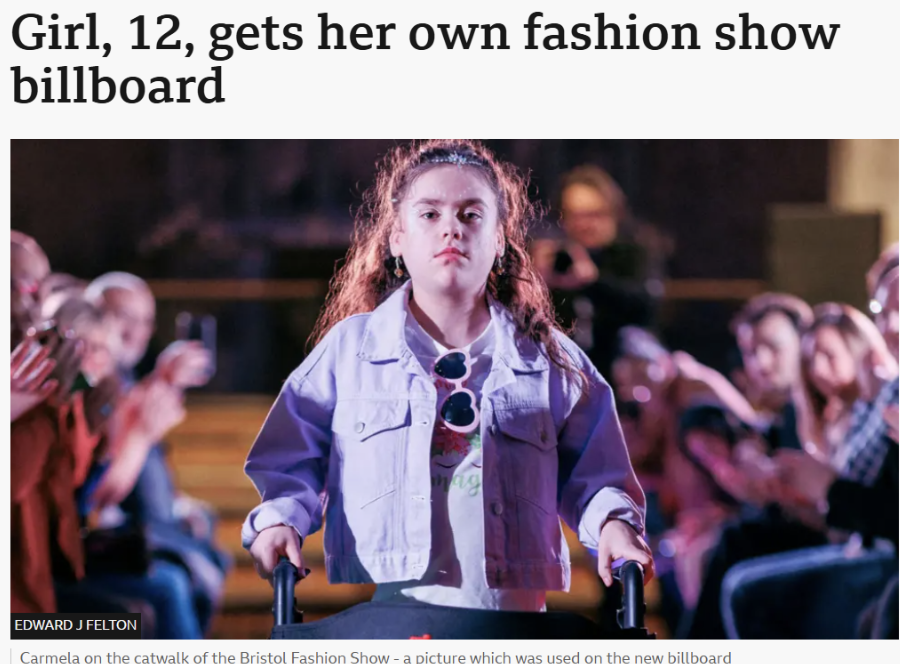
Celebrating Adaptive & Inclusive Design: A talented 12-year-old designer who lives with Down's syndrome has celebrated a major milestone after seeing her original creation featured on a high-profile billboard for an inclusive fashion show. The achievement highlights the vital importance of neurodiversity, adaptive fashion, and accessible platforms in championing young creative voices and fostering true representation across the fashion community. Read the full story on BBC News
As we look ahead to COP31 and the busy run-up to peak trading, the message across the board is clear: meaningful transformation isn't about ticking boxes, but embedding true accountability into every commercial decision. What stood out for you this month, and where are you seeing the biggest shifts on the ground?
As always, we'd love to hear your thoughts in the comments!