
The Great Reporting Reset - Buyer Beware
The Great Reporting Reset
Is the EU Dismantling Fashion Transparency? The EU’s Omnibus I Simplification Package has dramatically raised reporting thresholds for CSRD and CSDDD. What does this mean for transparency in the fashion industry?
In a dramatic move on 16 December 2025, the European Parliament approved the Omnibus I Simplification Package, a legislative pivot that has fundamentally altered the landscape of sustainability reporting. Originally designed to hold companies accountable for their environmental and social footprints, these laws are being "simplified" under the EU’s new Competitiveness Compass to reduce administrative burdens. But as the goalposts move, we must ask: is this a victory for business efficiency, or are we witnessing the systematic dismantling of corporate accountability?
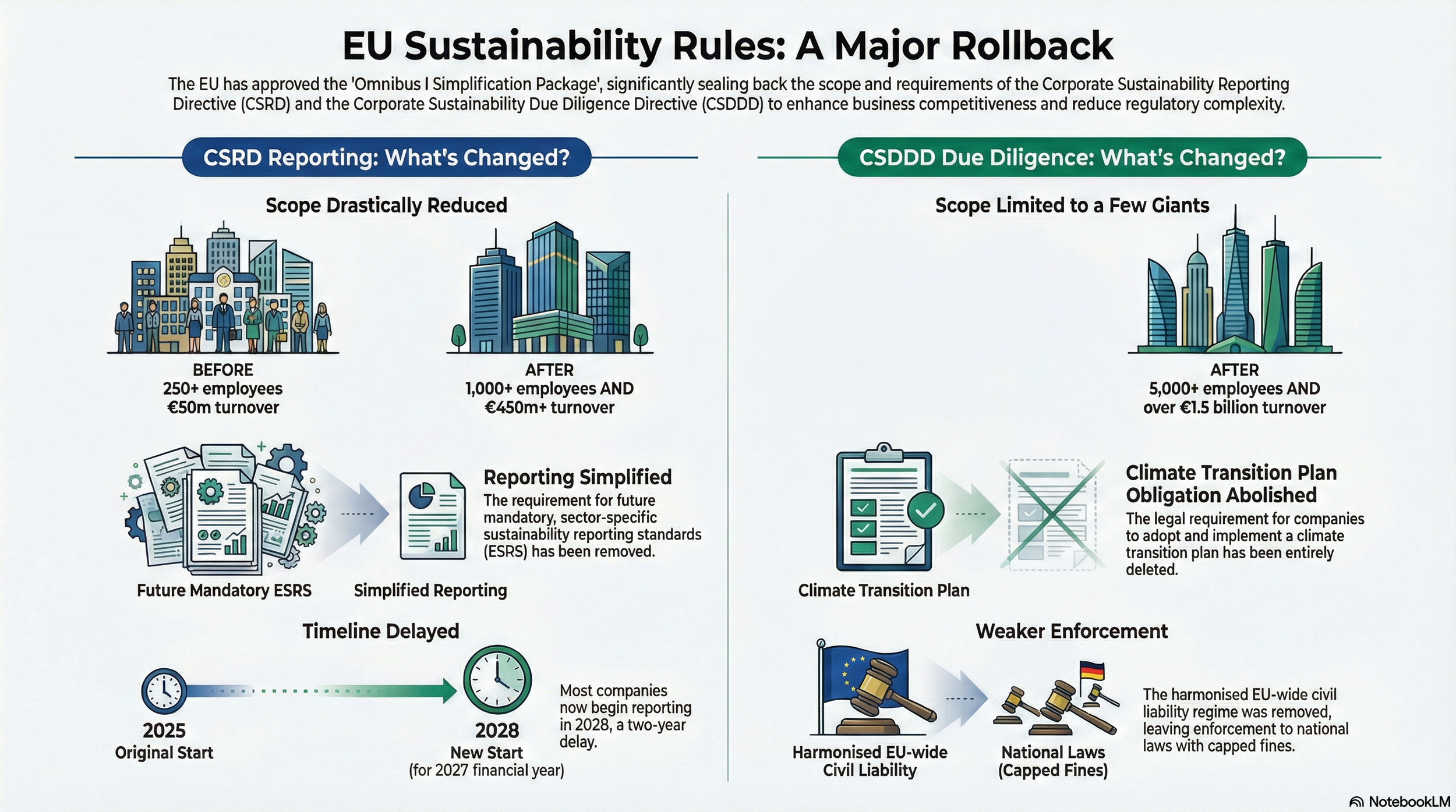
The Corporate Sustainability Reporting Directive (CSRD) was intended to be the gold standard for transparency. However, under the new revisions, the scope has narrowed significantly. Now, only fashion brands with more than 1,000 employees and €450 million in annual turnover are required to report. This excludes listed medium and small companies (SMEs), which are no longer covered by mandatory rules.
Sources highlight the introduction of the "protected undertaking" status. This allows business partners with fewer than 1,000 employees to reject information requests from larger brands if they exceed voluntary standards, effectively capping the "trickle-down" of transparency throughout the supply chain. Strikingly, the requirement for "reasonable assurance" (a high-level audit) has been scrapped, leaving only "limited assurance" as the mandatory standard.
The shift in the Corporate Sustainability Due Diligence Directive (CSDDD) is even more pronounced. Due diligence obligations now only apply to "giants" with over 5,000 employees and €1.5 billion in turnover. Experts estimate this change removes over 80% of companies that were previously expected to act.
The revisions do more than just change numbers; they alter the very nature of due diligence. Mandatory climate transition plans have been removed from the CSDDD entirely. Additionally, the requirement for detailed supply-chain mapping has been replaced by a "scoping exercise" based only on "reasonably available information". Critics argue this creates a form of "cosmetic compliance," where companies are granted immunity if impacts are not identified during these flexible scoping sessions.
One of the most contentious changes is the removal of a harmonised, EU-wide civil liability regime. Instead of a single legal standard, liability will be determined by 27 different national laws, which some describe as a "nightmarish legal patchwork" that makes it harder for victims of exploitation to seek justice. While brands like Primark and Nestlé have actually urged the Commission not to weaken these standards to maintain business certainty, the deregulation push has largely been driven by political and geopolitical pressures.
This shift suggests that the burden of proof is moving from the regulator to the consumer. If the law no longer forces mid-sized brands to be transparent, our collective voices must fill the gap. Implementation has been delayed, with CSDDD rules only applying to the largest firms by July 2029.
We must ask ourselves; if a brand is no longer legally required to disclose its impact, will it continue to prioritise the planet? This legislative reset is like removing the mandatory health ratings from food packaging; it doesn't mean the ingredients have changed, it just means the buyer has to look much closer to know what they are consuming.