
F1 is redesigning the race to net zero.Here’s what the sport actually did
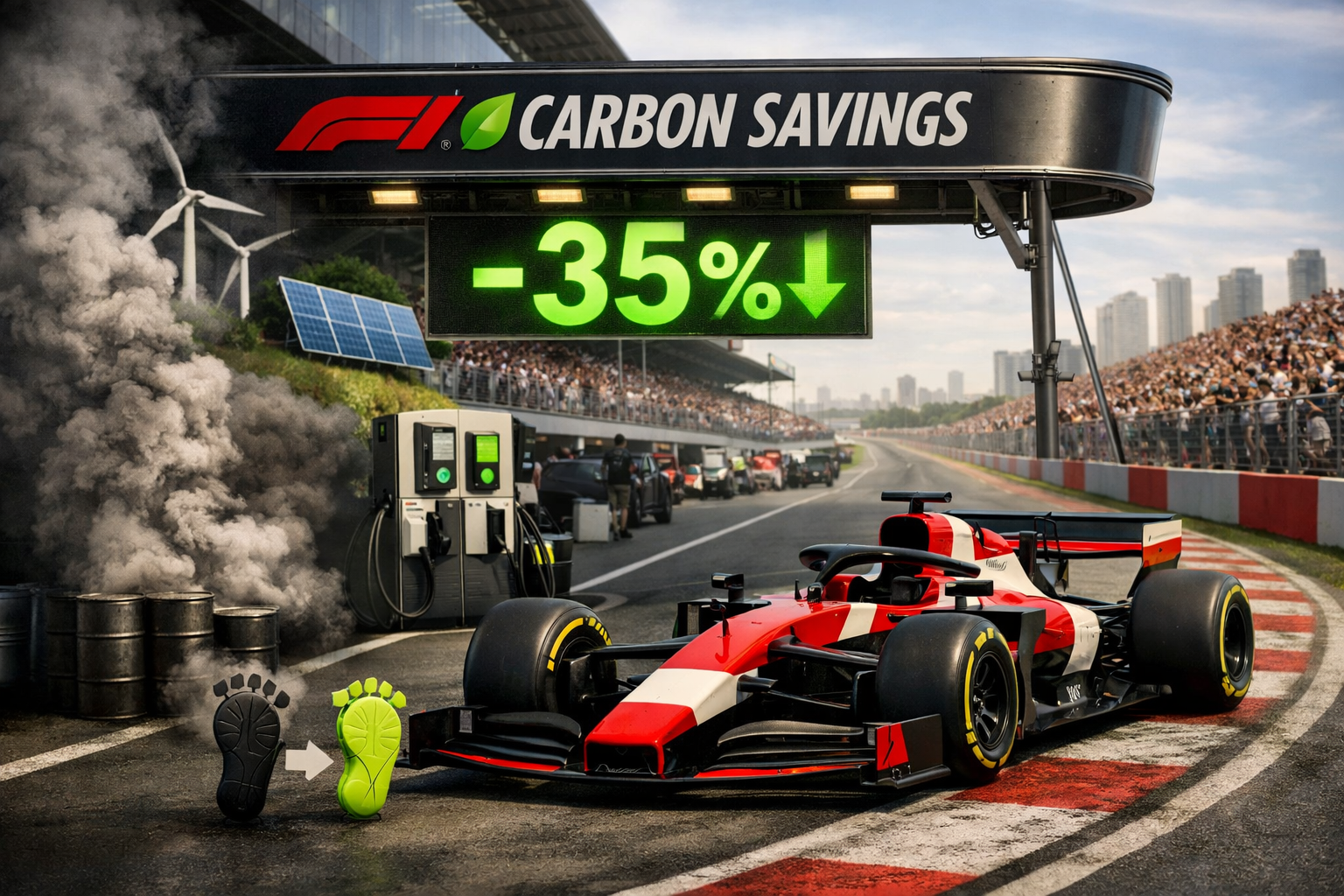
Image Ai Generated
“The cars on the track represent just 1% of F1’s total carbon footprint. The other 99% is where the sport quietly rewrote its operating model.”
It was a sporting weekend for England. Wimbledon in full swing. The F1 at Silverstone. And an epic win for England in Mexico, Jude Bellingham’s two goals in quick succession and a Harry Kane penalty enough to beat the hosts 3–2 at the Azteca, with ten men, in a match that will be talked about for years. We wanted to take a closer look at the environmental impact of some of these sports and this week, we focused on F1. Because while England were exorcising 40 years of Azteca demons, 564,000 people descended on Silverstone. The biggest crowd in the history of Formula 1, beating a 31-year record set in Adelaide, was treated to Charles Leclerc taking his first ever British Grand Prix win, ahead of George Russell and Lewis Hamilton, in a race that finished under the Safety Car after Max Verstappen beached his car in the gravel with four laps remaining. 175,000 of those tickets were for race day alone. A sport that not long ago was struggling to fill grandstands has become, by every commercial measure, one of the world’s most powerful entertainment properties.
That growth has happened in the same window F1 chose to take on the hardest operational redesign in its 76-year history.
That combination deserves more attention than it gets.
The baseline was bleak
In 2019, F1 calculated its total operational footprint at around 256,000 tonnes of CO₂ equivalent per season. A global championship moving 24 races worth of freight, people, and equipment across four continents, in a sport whose cultural identity had been built entirely on the combustion engine. Committing to Net Zero by 2030 wasn’t an easy headline. It was a structural challenge.
The sport’s 2026 Impact Report, published in June, confirms that F1 has now reduced its operational carbon footprint by 35% against that 2018 baseline, removing nearly 80,000 tonnes of CO₂ equivalent from operations in eight years. This is over halfway to the minimum 50% emissions reduction required to declare Net Zero by 2030. And it happened while the race calendar expanded from 21 to 24 events and global attendance grew from 4 million to 6.5 million fans per season.
The fix wasn’t a values statement. It was a systems redesign.
The changes F1 made are worth examining in some detail, because the logic behind them applies well beyond motorsport - could it even stretch to fashion? At Our Fashion Fix we think there are lessons to be learnt.
Freight and logistics accounted for almost half the sport’s footprint. So that’s where the work started. European race freight was switched from diesel trucks to biofuel, derived from waste cooking oils and agricultural residues - reducing related emissions by 83% in a single operational change. The existing truck engines stayed the same. The fuel changed.
The race calendar was restructured not for commercial reasons, but to minimise intercontinental travel. Japan moved from September to April to create a coherent Asia-Pacific segment. Azerbaijan was scheduled alongside Singapore. Qatar was moved to sit next to Abu Dhabi. From 2026, Canada races earlier in the year to remove an additional transatlantic freight crossing before the European summer leg begins. These are not small adjustments, each one was contested commercially but the cumulative logistics saving is measurable and compounding.
F1’s factories and team facilities, meanwhile, have transitioned almost entirely to renewable energy. Factory and facilities emissions are down 64% against 2018. All ten F1 teams now run their facilities on renewable sources. The sport made its first investment in sustainable maritime fuel in 2025, establishing a long-term lower carbon option as freight increasingly moves from air to sea. By 2030, over 50% of F1’s current broadcast and freight cargo currently flown will have been rerouted to sea freight.
Broadcast operations were redesigned to be predominantly remote, cutting the volume of technical equipment and the people needed to operate it required at each race. Travel-related emissions are down 27% against 2018. An investment in Sustainable Aviation Fuel for air charter operations has produced an approximate 40% reduction in related air charter emissions.
And from the 2026 season, all F1 cars are running on advanced sustainable fuel developed in partnership with Aramco over three years and more than 39 blend tests - that reduces CO₂ emissions by 85-96% compared to conventional fuel. It’s designed as a ‘drop-in’ fuel compatible with most conventional road car engines. The ambition is not just to decarbonise F1. It’s to prove the fuel at scale so it can move into the 1.8 billion cars already on the world’s roads.
The lesson from the pit wall
At our Retail Jam Future Leaders session just last week, we set F1 against the 2026 FIFA World Cup in a head-to-head on sustainability. The comparison is instructive. F1: 24 races, 11 teams, a global travel circuit. The World Cup: 48 teams, 104 matches, 16 cities, three countries. The World Cup is projected to produce around 7.8 million tonnes of CO₂ equivalent - more than double the carbon footprint of Qatar 2022 with roughly 88% of that coming from fan travel alone.
“F1 redesigned its calendar to cut travel. The World Cup expanded its scale across three countries. Same era. Opposite design choices. Opposite results.”
Scale and structure decide your footprint. Not good intentions alone.
F1 is not a perfect story. Its total footprint, when you include the 564,000 fans who drove or flew to Silverstone this weekend, is estimated at closer to 1 million tonnes per season. Fan travel is the biggest unresolved variable, and it’s one that a sport with Silverstone’s logistical constraints cannot easily control. F1’s own sustainability reports are transparent about this gap.
But the operational redesign - freight, energy, logistics, calendar structure, broadcast is genuinely significant. The direction has not shifted. The commitment has not softened. And the commercial growth has not been used as a reason to slow down.
Fashion took to the track too.
While F1 was making sustainability headlines, M&S was making a different kind of history in the same postcode. On 2nd July, the retailer staged the first-ever fashion show on Silverstone’s pit lane - 50 models walking through the working garages, set against the backdrop of team cars and race-day engineering, in front of a guest list spanning fashion, motorsport and culture. The “Dress to Thrill” summer edit was built around versatility and longevity: pieces designed to work across the season rather than be worn once, a colour palette of monochrome and soft neutrals punctuated by hits of racing red. It was bold, it was well-executed, and in front of a global F1 audience of over 1.8 billion cumulative viewers, it was commercially very smart.
The activation sits within a multi-year partnership with Silverstone and a collaboration with the Atlassian Williams Racing team as their official travel kit partner. M&S was named the UK’s best brand for the fourth consecutive year in YouGov’s 2026 rankings. This is not a coincidence. The brand has been methodical about showing up at the moments that matter to its customers and Formula 1, with its record-breaking crowds and genuinely global reach, is one of the biggest cultural platforms in the UK right now.
It’s worth noting that M&S is also one of the few high street retailers actively building circular models into its operation - its repair and alterations partnership with Sojo being one of the more credible examples of a mainstream brand moving circular design from a values statement into an actual customer service. The Silverstone show was a brand moment. The Sojo partnership is an operational one. Both matter. The brands that are winning right now are doing both at the same time.
What this means for fashion
The lesson here isn’t that fashion should follow Formula 1. It’s that the structural logic is the same.
Emissions don’t sit in a sustainability department. They sit in logistics decisions, energy contracts, sourcing choices, and how you move product around the world. The fixes when they’re built into the operating model rather than bolted on as an initiative compound over time, and many of them generate commercial efficiencies alongside the environmental savings. If you are following our articles you will know that this is actually where Ask Miranda® helps buying teams understand their impact and costs associated before purchase- it doesnt need a fancy system to plug into - it works with the information you have and plugs any gaps with archetype data so that we move forward proactively.
F1 didn’t wait until it had a perfect solution before moving. It started with biofuel in European trucks and renewable energy at its factories. It restructured its calendar at commercial cost to reduce freight miles. It invested in sustainable fuel technology not knowing exactly how it would land, but with a clear view of where it needed to get to.
The cost of moving slowly is now bigger than the cost of not moving. That’s true for a global sport. It’s equally true for a UK fashion business facing EPR, ESPR, and a regulatory landscape that is moving in one direction only.
Our Fashion Fix works with buying and commercial teams to make sustainability the language of commercial strategy - not a separate agenda, because the best businesses we have worked in worked as a TEAM not in siloes.
Read our full June 2026 sustainable fashion update: ourfashionfix.com/monthly-updates/monthly-update-june
DM to become a design partner for Ask Miranda®
Subscribe to our monthly newsletter at ourfashionfix.com